

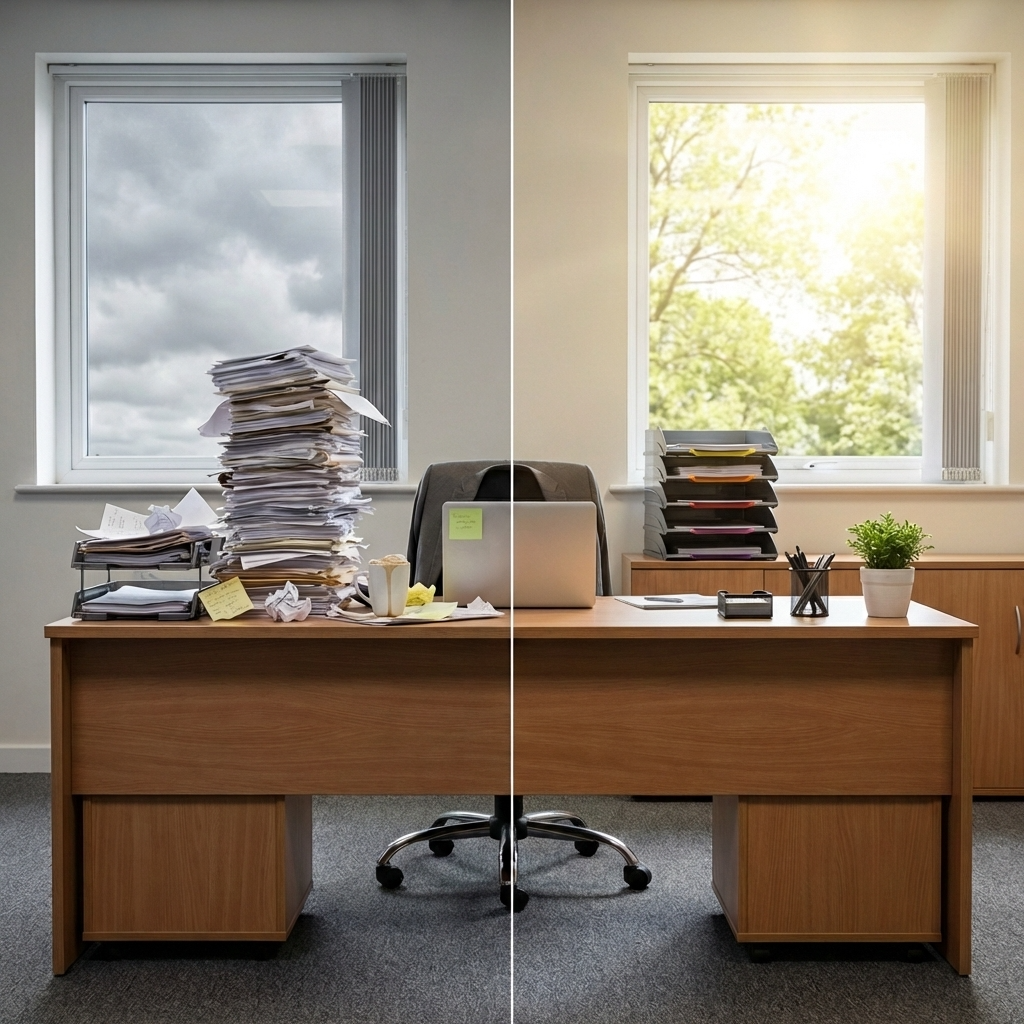
Desk organisation can be the quiet reason your day feels heavier than it should.
For many office workers, that overwhelmed feeling doesn’t come from one big problem.
It’s usually the small frustrations that repeat all day long.
The charger you can’t find.
The document you need, buried under a pile.
The pen that disappears every afternoon.
The awkward reach for a notebook that should really be closer.
None of these are major issues.
But over the course of a day, they quietly slow you down.
Spring is often framed as a time for perfectly organised ‘Pinterest’ desks.
But real offices don’t need perfection.
They need less friction.
Often, what’s missing isn’t effort.
It’s better desk organisation and a clearer system.
Sometimes, the difference between a frustrating day and a smooth one comes down to a 15-minute reset of your workspace.
Desk organisation: a 15-minute reset that reduces friction
The 15-Minute Desk Reset Framework
Instead of trying to overhaul everything, focus on three simple steps.
Clear. Keep. Reposition.
This approach works because it’s practical.
It’s not about aesthetics.
It’s about making your desk work with you.
A good reset also makes it easier to keep your organisation consistent day to day.
1. Clear (5 minutes)
Start by clearing everything off your desk that doesn’t belong there.
Not forever.
Just temporarily.
As you do, ask yourself one question.
“Did I actually use this today?”
If the answer is no, it probably doesn’t need a prime spot on your desk.
This is the fastest way to restore desk organisation without making it a big project.
Common culprits include:
Old paperwork that’s already been actioned
Excess stationery
Loose cables and chargers
The goal isn’t minimalism.
Good desk organisation starts by removing items that don’t support your workflow.
It’s also about removing the noise that competes for your attention.
If something keeps landing on your desk “for later,” notice that pattern.
Give it a home nearby, or decide what “later” actually means.
That tiny decision saves time the next time you sit down.
2. Keep (5 minutes)
Now bring back only the items that genuinely support your daily workflow.
A helpful rule of thumb is simple.
What do you use 10 or more times a day?
That’s what deserves attention.
Typically, this includes:
Notebook or planner
Keyboard and mouse
Phone or headset
Frequently used documents
Essential stationery
Everything else can live nearby.
But not directly on your desk.
That difference matters because a clear surface supports quicker decisions.
It also reduces the urge to shuffle piles between tasks.
This is where practical workspace tools quietly make a big difference.
Simple storage trays, drawer organisers, or desk accessories can keep essentials accessible without creating clutter.
The goal of desk organisation isn’t to add more things to the desk.
It’s to give the right things a proper place.
If you share a workspace, keep the “daily essentials” standard the same.
It helps prevent clutter from rebuilding between meetings and handovers.
Even small habits, like putting one item back after each task, reinforce desk organisation over time.
3. Reposition (5 minutes)
Now comes the step most people skip.
Thinking about movement.
If you have to repeatedly reach, stand up, or dig through piles to access something, it’s in the wrong place.
These tiny delays don’t look like much in the moment.
But they add up across a day.
Consider:
Moving your notebook to the dominant-hand side
Keeping chargers or cables secured instead of trailing
Placing frequently used files in vertical organisers within arm’s reach
Moving less-used items into desk drawers or nearby storage
Small adjustments like cable management clips or simple desk organisers can remove a surprising amount of daily friction.
Not because they only look tidy on day one.
But because they stop small annoyances from interrupting your flow.
Try noticing where your hand naturally goes during the day.
If you keep reaching to the same awkward spot, that’s a clue.
Move the item once, and the improvement repeats every time you work.
A Spring Reset That Actually Lasts
Spring cleaning isn’t about creating a perfect workspace that lasts one afternoon.
It’s about identifying the little obstacles that slow your work down.
Then removing them.
Start with 15 minutes.
Clear. Keep. Reposition.
You may discover that the problem wasn’t your workload after all.
Sometimes your biggest productivity boost comes from improving your desk organisation.
So your workspace finally works the way it should.




Leave a comment
All comments are moderated before being published.
This site is protected by hCaptcha and the hCaptcha Privacy Policy and Terms of Service apply.